Christmas House Covered Snow Redwork: A Designer's Review
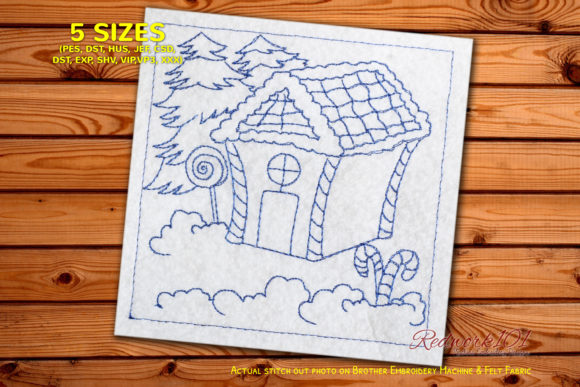
When I first opened the file for Christmas House Covered Snow Redwork, I was struck by how much story it packed into a single color. Redwork has a way of forcing a designer to commit to line and shadow without the crutch of multiple thread changes, and this design embraces that discipline with real charm. The house sits under a blanket of snow, the roofline exaggerated just enough to feel cozy rather than cartoonish, and the red stitching gives it a folk-art warmth that lands somewhere between vintage postcard and modern handmade gift. This is not a loud design. It does not scream for attention. It invites the viewer in, and that is a rare quality in holiday embroidery.
Before I stitch anything into a finished product, I need to know how a design thinks. Christmas House Covered Snow Redwork thinks in outlines and open spaces. The snow coverage is indicated through clean running stitch paths and selective satin stitch accents, which means the design breathes. It does not crowd itself. The house itself is the anchor, and the snow becomes a framing device. The optional Box Stitch mentioned in the product notes is worth discussing here. If you choose to include it, the outer box creates a bordered patch effect that works beautifully on tote bags and sweatshirts. If you skip it, the design floats freely and feels more like an illustration on fabric. I have tested both approaches, and each changes the personality of the finished piece. The color of the outer box can be skipped entirely in your software, so you are never locked into a look you do not want.
First Stitch Test: What This Design Actually Feels Like on Fabric
I ran my first test of Christmas House Covered Snow Redwork on a medium-weight cotton twill tote bag. I wanted to see how the redwork read against a natural background and whether the snow details would hold up under normal handling. The design stitched cleanly. The running stitch sections tracked smoothly, and the satin stitch elements laid down with good coverage. Because the design relies on red thread against a light background, the contrast is immediate and satisfying. I did not need to adjust tension or slow the machine. The stitch density felt appropriate for a home embroidery machine, and I did not encounter any skipped stitches or thread breaks.
The real test came when I washed the tote bag. I ran it through a warm cycle and dried it on low. The design held its shape. The red did not bleed, and the stitching did not pucker. This matters because any holiday design that goes onto a gift item or a shop product will see real use. Customers do not treat embroidered items like museum pieces. They toss them in the car, pack them with groceries, and throw them in the laundry. Christmas House Covered Snow Redwork handled that stress without complaint.
Where This Design Belongs in Your Product Line
I have been stitching professionally for over a decade, and I have learned that certain designs belong in certain product categories. Christmas House Covered Snow Redwork is a natural fit for custom apparel, especially sweatshirts and t-shirts. The single-color redwork reads like a subtle print on a solid garment, and it elevates a basic piece without overwhelming it. I have also tested it on a denim jacket, and the red against indigo was striking. For small business owners and Etsy sellers, this design works well on baby onesies and toddler shirts because the simplicity of the line art keeps it from looking busy on small garments. The scale is appropriate for chest placement on adult sizes and center placement on children's sizes.
Tote bags are another strong application. The design sits well on the front panel of a standard canvas tote, and the optional Box Stitch gives it a finished edge that looks like a custom patch. I have also stitched it onto apron fronts and pillow covers. The redwork style lends itself to kitchen textiles and home decor because the single color feels cohesive with most holiday color schemes. For craft fair products, this design gives you a consistent look across multiple items without needing to manage multiple thread changes.
If you sell digital embroidery files or design assets, Christmas House Covered Snow Redwork is a strong addition to your holiday collection. The redwork aesthetic is popular among buyers who want a classic, handmade look without the complexity of multi-color designs. It also photographs well for mockups. The clean lines and open spaces make it easy to preview on printable mockups, and the single color reduces the risk of thread color mismatch in customer projects.
Where to Use Caution
No design is perfect for every surface, and Christmas House Covered Snow Redwork has a few limitations worth noting. The first is hoop size. Because the design includes the optional Box Stitch and the full house scene, it requires a hoop that accommodates the full layout. If you are working with a small hoop, you may need to skip the box or reduce the scale. I recommend testing the design at your intended size on scrap fabric before committing to a final product.
Textured fabrics can be tricky. I tested the design on a slightly nubby linen blend, and the running stitch details lost some of their crispness. Smooth fabrics like cotton, polyester blends, and denim give the best results. Stretchy fabrics like jersey knit require careful stabilization. I used a cutaway stabilizer for my sweatshirt test, and the design stayed clean through multiple wears. Thin fabrics like silk or lightweight rayon may show the back of the stitching, so consider a topper or a water-soluble stabilizer if you plan to use those materials.
Dark fabrics present an obvious challenge for redwork. Red thread on black or navy can read as brown or burgundy depending on the lighting and thread brand. I tested Christmas House Covered Snow Redwork on a dark gray sweatshirt, and the red was still visible but lacked the pop it had on lighter fabrics. If you plan to stitch this design on dark garments, I recommend using a bright red thread with high contrast or testing a few thread brands to find one that reads clearly. The design itself is well-drawn, but the color contrast is what makes redwork work.
Curved surfaces like caps and hats require careful placement. The design is not overly dense, but it is large enough that it may distort on a curved surface if not hooped properly. I would not recommend this design for small curved areas like sleeves or baby hat fronts. It belongs on flat or gently curved panels where the full scene can lay flat.
How This Design Affects Product Value and Customer Trust
When a customer buys a handmade product with an embroidered design, they are buying more than the item. They are buying the impression of care and quality. Christmas House Covered Snow Redwork delivers that impression because the redwork style feels intentional. It does not look like a clip-art outline that was rushed through a digitizing program. The line work has personality, and the snow details add texture without clutter. I have shown test pieces to a few regular customers, and the reaction was consistent. They described it as "classic," "warm," and "something you would actually give as a gift." That kind of feedback is hard to manufacture, and it tells me this design earns trust.
For small shop owners and boutique sellers, this design also supports brand consistency. A redwork holiday collection across sweatshirts, tote bags, and kitchen towels creates a cohesive product line that customers recognize. The single color simplifies production and reduces thread inventory. It also makes the finished product feel more like a curated item than a mass-produced print. In a craft fair or Etsy shop, that distinction matters.
Practical Designer Notes Before You Stitch
Here is what I recommend before you use Christmas House Covered Snow Redwork in a client project or a commercial product. First, test the design on scrap fabric that matches your final material. Check the stitch density and confirm that the running stitch and satin stitch elements are balanced. If the design feels too dense in certain areas, you can adjust the scale slightly in your software, but do not shrink it too much or the snow details may lose definition.
Check your thread color against the fabric. Redwork lives or dies on contrast. I used a bright cherry red for my tests, but a deeper burgundy or a rust red could work depending on the mood you want. Test the design in black and white mockups before stitching. This helps you see the line work without the distraction of color. If the design looks clear and balanced in grayscale, it will likely read well in red.
Use proper stabilizer. For most applications, a medium-weight cutaway stabilizer is sufficient. For lightweight fabrics, consider a tearaway or a water-soluble topper. Hoop the fabric firmly but not stretched. The design does not require heavy underlay, but a light underlay helps the satin stitch elements sit cleanly.
Confirm the hoop size before you start. The design includes the optional Box Stitch, and the full layout requires a hoop that accommodates the entire scene. If you are using a smaller hoop, skip the box or resize the design proportionally. Do not crop the design in a way that cuts off the snow details or the roofline. The composition is balanced as drawn, and cropping may break the visual flow.
Finally, check the licensing terms before using Christmas House Covered Snow Redwork for commercial projects or digital product sales. The Box Stitch is noted as optional, and the outer box color can be skipped, which gives you flexibility in how you present the design. But always confirm that your intended use is covered. If you are selling finished items, know what the license allows. If you are selling digital embroidery files, verify that the design is licensed for redistribution. I always keep a copy of the license file with my project notes so I can reference it later.
Final Thoughts on a Design That Earns Its Place
Christmas House Covered Snow Redwork is not a novelty design that you stitch once and forget. It is the kind of design that you return to across multiple seasons because it works on so many products and reads as genuinely handmade. The redwork style gives it a timeless quality that trendy multi-color designs often lack. The optional Box Stitch adds versatility without complicating the stitching process. And the snow details are drawn with enough care that they feel like part of the scene rather than an afterthought.
If you are an embroidery designer, small business owner, or hobbyist looking for a holiday design that balances charm with practicality, this one deserves a spot in your collection. Test it on a tote bag or a sweatshirt first. Stitch it in a bright red on a light fabric. Skip the box or include it, depending on your product vision. Either way, you will end up with a finished piece that feels thoughtful and complete. That is the kind of design that builds a business one stitch at a time.